

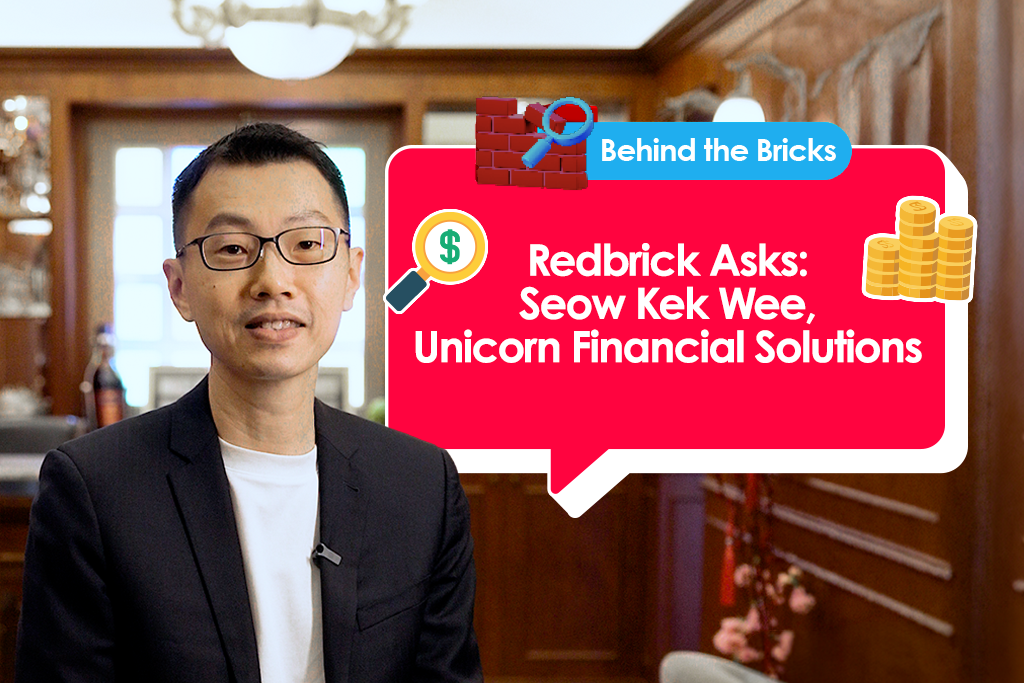
In a world obsessed with quick returns and maxing out leverage, Seow Kek Wee offers a refreshing—and vital—dose of financial reality. As the Chief Investment Officer at Unicorn Financial Solutions, Kek Wee brings over two decades of wealth management experience to the table, taking this interview at The Arizon on Geylang Road.
From his sanctuary in Sembawang to the Warren Buffett frameworks, Kek Wee shares his deeply principled philosophy on wealth. Dive into his candid insights to discover why buying your dream house shouldn’t cost you a rich life and how you could navigate the psychological traps of debt.
Q. What’s one piece of advice you would give to first-time homebuyers?
Kek Wee: Determine your true home budget through a holistic view of your family’s wealth, rather than just focusing on down payments and monthly repayments.
I once met an investor in his 50s whose family had an annual income of more than $300,000. He had been renting for years and finally wanted to buy a home. After reviewing his finances, I told him that he couldn’t actually afford a condominium. He was shocked. He pointed out that many younger people earning much less than him were buying condominiums.
I explained to him that while these young couples might be able to manage the initial down payment and monthly repayments, that doesn’t mean they can truly afford the home. Over a lifetime, a family faces many other responsibilities and lifestyle choices. We need to consider all of these factors holistically before we can confidently and safely measure true affordability.
Otherwise, you could end up with a dream home, but a poor life.
Q. Is there a ‘best time’ to buy a property?
Kek Wee: It all depends on what the property is for.
If you are buying a home—especially within an Asian context where owning is often preferred over renting—my advice is usually to go ahead and buy now, provided it’s a place you love and can truly afford. We all need a place to live. If you define the “best time to buy” as waiting for a market correction to get a lower price, that moment might not come for years. By then, even after a correction, prices may still be higher than they are today. In the meantime, you face the cost of waiting: the rent you are paying out of pocket.
If you are buying for investment, however, timing matters. There is still no single “best” time because investing is all about relative value. When a property is purely an investment, you have to weigh it against alternatives like equities, bonds, precious metals, or even cash. Only by assessing the current economic environment, valuations, expected returns, and volatility can you decide what is “best” at any given moment.
Q. Would you buy a home to live in, or as an investment?
Kek Wee: For me, a home is always meant for living. I have never viewed my primary residence as an investment.
If I were to treat my home as an investment, I would constantly have to monitor the property market and time the buying and selling. Plus, whenever I sold, I’d have to arrange interim rental housing. I find that entire process incredibly cumbersome, especially since I devote most of my time to my career.
In addition, I place much more value on a home than a house. Because of this, I am perfectly content with my sanctuary: a 5-room HDB flat in Sembawang. Keeping my housing costs as a relatively small proportion of my overall net worth frees up the rest of my assets for serious, dedicated investing.
Q. When choosing a home loan, do you prefer fixed or floating interest rates?
Kek Wee: I am open to both options; it ultimately depends on my economic outlook and the spread between the two.
Currently, I prefer a floating-rate loan because they cost less than fixed-rate alternatives right now. My view is that we are about to enter a period of deflationary growth, driven by massive productivity boosts and disruption from artificial intelligence. This structural shift suggests that interest rates should head downward rather than upward. Of course, this is just my perspective—economic forecasting is notoriously difficult, and I could easily be proven wrong.
Q. When taking a loan, do you think it is better to borrow more or pay it off as quickly as possible?
Kek Wee: Looking strictly at financial risks and rewards—and setting aside personal emotional preferences, as some people are naturally uncomfortable with debt—I prefer to borrow more.
This is because mortgage loans offer unique advantages:
- They are low-cost: Mortgage debt tends to be the cheapest form of leverage available to most retail borrowers.
- They offer long tenures: The repayment runway is exceptionally long since it is tied to the useful life of the underlying property.
- Low margin-call risk: Unlike equities, properties are not marked to market on a daily basis, significantly lowering the risk of forced liquidation during a downturn.
Given these structural characteristics, real estate is one of the best vehicles for leverage. This leverage can be applied directly to the property itself or unlocked via an equity term loan against a private property to invest in other asset classes.
To be responsible, I must qualify this: before taking on significant debt, rigorous risk management must be conducted by a qualified professional. The borrower must be able to safely navigate various stress-test scenarios, and the unlocked capital must be put to highly productive use for the leverage to be truly valuable.
Q. What advice would you give someone who wants to start investing in property?
Kek Wee: I must qualify this by saying I am no expert in property investing; my primary focus is investing in wonderful companies. However, property investing shares many commonalities with all other forms of investing.
If I had to offer three pieces of advice, they would be:
- Respect the Leverage: Property investing usually involves serious leverage. Debt makes your returns look incredibly sexy when the market is on your side. But if you throw caution to the wind and the market turns against you, it can financially kill you. Always establish disciplined risk management rules and stick to them. Making less money is a temporary discomfort; drowning in massive debt can be permanently fatal.
- Master the Craft: Your investment profits have less to do with what you invest in, and much more to do with how good you are at it. Invest in yourself first by learning from people who have been there and done that. Then, start small and learn from your own mistakes.
- Protect your Circle: Cultivate a conscious, willing choice to surround yourself with mature and grounded people. We naturally become who we associate with. If you run with the wrong crowd, I guarantee that principles one and two will quickly be thrown out the window—and the ending won’t be pretty.
Q. Who or what influenced the way you think about investing?
Kek Wee: When I first started investing in 2001, everything I touched turned to dust. For a good two years, I was a complete failure at it. I was simply chasing investment ideas by reading reports and magazines, entirely lacking a proper framework or process.
Everything changed in 2003 when a former colleague gave me a book called The Warren Buffett Way. It gave me a structured framework and completely flipped my perspective: I stopped acting like a casual stock trader and started thinking like a true business owner. This radically transformed my investment results. To this day, I consider Warren Buffett to be my first mentor.
Later, my professional journey at Unicorn helped me adapt that foundational philosophy to a rapidly changing market environment. I am incredibly grateful for my professional associations at Unicorn; they have helped challenge and shape my thinking over the years, ensuring my approach remains sharp and relevant.

Source: Unicorn Financial Solutions
Finally, my Chairman, Mr. Patrick Tan, alongside my own market observations, taught me how to navigate the inherent vagaries of asset prices. A vivid turning point for me was during the onset of the Global Financial Crisis in 2007, when asset prices plummeted by more than 50%. Having just joined Unicorn, I was absolutely petrified. However, I watched firsthand how my Chairman emerged as a victor rather than a victim of the crisis. He did it by deeply understanding market sentiment and staying fiercely steadfast to our investment framework.
Q. Do you think property is a good way to build long-term wealth?
Kek Wee: I believe Singapore real estate remains an excellent vehicle for long-term wealth creation, thanks to our robust economy, strong governance, limited land supply, and access to highly attractive leverage. However, I cannot say the same for all real estate markets; in fact, I am generally quite wary of investing in foreign properties.
Nevertheless, I would strongly advise against concentrating your wealth solely in Singapore real estate for two reasons:
- It is a leveraged play on a single nation: Local properties are invariably a highly leveraged proxy for the long-term health of our domestic economy. While I believe Singapore is on the right path, we must still diversify intelligently to manage our systemic risks properly.
- Growth is stabilizing in a mature market: As a mature economy, Singapore will likely see future property price appreciation that is more modest than the explosive growth of the past. If we skillfully curate our overall portfolios and select alternative assets, there are plenty of global opportunities capable of delivering higher returns than Singapore property alone.
Q. Do you think owning property should be part of your retirement plan?
Kek Wee: Yes, for high-net-worth individuals. No, for those with a lower net worth. If I had to draw a line separating the two groups, it would be around $3 million.
When I refer to investment properties, I specifically mean Singapore real estate. For most locals, a lack of transparency and a general unfamiliarity make overseas properties far too risky unless they are true real estate experts.
In Singapore, the minimum cost of a decent investment property is roughly in the $1 million region. When you add that to a family’s primary residence, you are looking at around $2 million in real estate alone. Assuming these properties are fully paid up to enjoy debt-free rental income for retirement, a family with a $3 million net worth would still have $1 million left in liquid, non-property assets. This provides a healthy, baseline level of diversification.
However, if a family’s net worth is below $3 million, adding an investment property causes their wealth to become dangerously concentrated in real estate. For them, it is far more suitable to build an intelligently curated, diversified portfolio of liquid assets like equities, bonds, precious metals, and REITs. This way, they still maintain exposure to real estate, but through the liquidity of the public markets.
Personally, I have owned, and currently own, real estate beyond my primary home, so I speak from direct experience.