

In 2012, a couple, both 29, walked away from their first HDB with $300,000 in profit. Two options sat in front of them.
A 3-room HDB flat at $317,500. Or a resale EC at $763,000.
They chose the HDB. Safer. More manageable. Right for where they were in life, a newborn arriving, routines forming.
What was meant to be a short stop became 9 years. When they sold in 2021, the flat went for $305,000. A slight loss.
That EC? It was worth $1,000,000.
“The biggest gaps in property wealth are rarely created by one bad decision. They’re created by good decisions, made once, and never revisited.”
Here’s the thing: that gap wasn’t created by a mistake. It came from a decision that made complete sense at the time, then stayed in place long after it stopped serving them. And that’s what a first property really is. Not just what you buy, but the trajectory it sets.
Run the numbers on both paths
Take a couple earning $10,000 a month combined, like plenty of young families at this exact crossroads.
Path one: an HDB resale at $600,000, grants bringing the effective loan down to around $350,000. Path two: a private resale at $1,300,000, loan of about $975,000. Both within reach.
Fast forward five years at conservative growth: 3% a year for the HDB, 4% for the private. The HDB sits at around $696,000 with $294,000 left on the loan: roughly $402,000 in equity. The private unit, about $1,590,000 with $850,000 outstanding: roughly $740,000 in equity.
Private wins. Clearly, in pure equity terms. But look underneath it. The private route means carrying a loan that’s $625,000 larger, with monthly commitments that leave far less room for what a decade actually throws at you. A career change. A medical bill. A stretch of single income during parental leave. A rate cycle turning against you.
| 💰 What the numbers actually show On a $10,000 combined household income, the private route generates roughly $340,000 more equity over five years. It also demands $625,000 more in loan commitment, a higher monthly outgoing, and far less financial margin if income drops, rates rise, or life changes. The equity gap is real. So is the risk gap. |
Where you live changes the math
Then there’s geography.
At $10,000 combined income, the property type you choose largely decides where you’ll live. Go HDB and you can land in a mature estate. Near the MRT, established schools, daily infrastructure that just works. Stretch into private at the same income and you’re often compromising on location: newer estates, less central corridors, places where convenience is still future-tense.
That trade-off matters more than it looks. Location shapes your commute, your rental demand later, your tenant pool, your exit price. A well-located HDB in a mature town can offer more consistent demand than a private unit still waiting for its catchment to arrive.
The gap doesn’t stand still
Back to our couple. The story didn’t end in 2021. Flat sold, they faced the same crossroads again: a 4-room HDB at $415,000, or that same EC, now at $1,000,000.
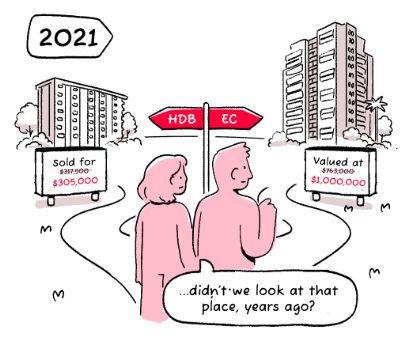
They chose the HDB. Again.
By 2026, the flat is potentially worth $600,000. The EC is reaching $1,500,000. The gap has widened from roughly $700,000 to $900,000 in five years. Not because they made bad calls, but because each reasonable decision compounded in the same direction. Stability over stretch. Comfort over progression. The present over the future.
This isn’t a story about regret. Most families would’ve done the same. But that’s how compounding works in property: the direction of your first decision tends to persist. Not because circumstances force it, but because comfort and inertia and “it’s not the right time” are always in the room.
It’s not HDB versus condo. It’s alignment.
Both are legitimate wealth-building assets. The real question is what you’re optimising for over your first decade, and whether the property actually serves it.
Starting with HDB makes sense when cash flow is the priority. When you need breathing room as life changes, or when private would leave no margin for error. Bought strategically, an HDB is a real launchpad. It builds equity, rents out after the MOP, and lets you upgrade from strength rather than pressure.
Going private early makes sense when you’ve got the runway for the bigger commitments and a clear view of the path you’re building toward. It compounds faster, attracts stronger tenants, and offers more flexible exits. The risk is higher. That’s not an argument against it, just a condition you accept with eyes open.
The mistake is never in the choice. It’s in making it without understanding the trajectory it sets, then never looking at it again.
One last thing
That couple in 2012? That was my wife and me.
The flat we sold at a loss, the EC we passed on twice, the 9 years that were supposed to be three. All ours. And honestly? I don’t think we got it wrong. Given what we knew then, we’d make the same first call again.
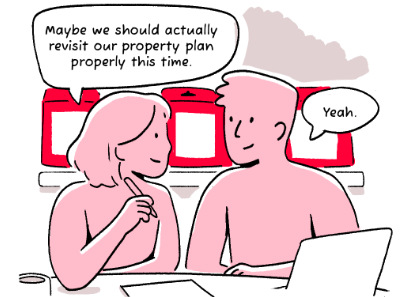
But I’d revisit it. That’s the part I’d change. Not the decision, the silence after it. Because the most expensive thing in our property journey wasn’t anything we bought. It was a good decision we never looked at twice.