

Most people walk into a property viewing and ask themselves how the space feels—but Alvin Chow wants you to look deeper and beyond. As the co-founder of Dr. Wealth, Alvin has built his career on factor investing, an entirely data-driven framework that relies on empirical evidence rather than gut instinct.
Alvin brings an analytical lens to the Singapore property market. He explains why trying to time the market can end up being “penny wise and pound foolish”, how to use bank leverage to safely supercharge your returns, and why mixing a “homestay” mindset with an investment strategy is a recipe for bad financial health.
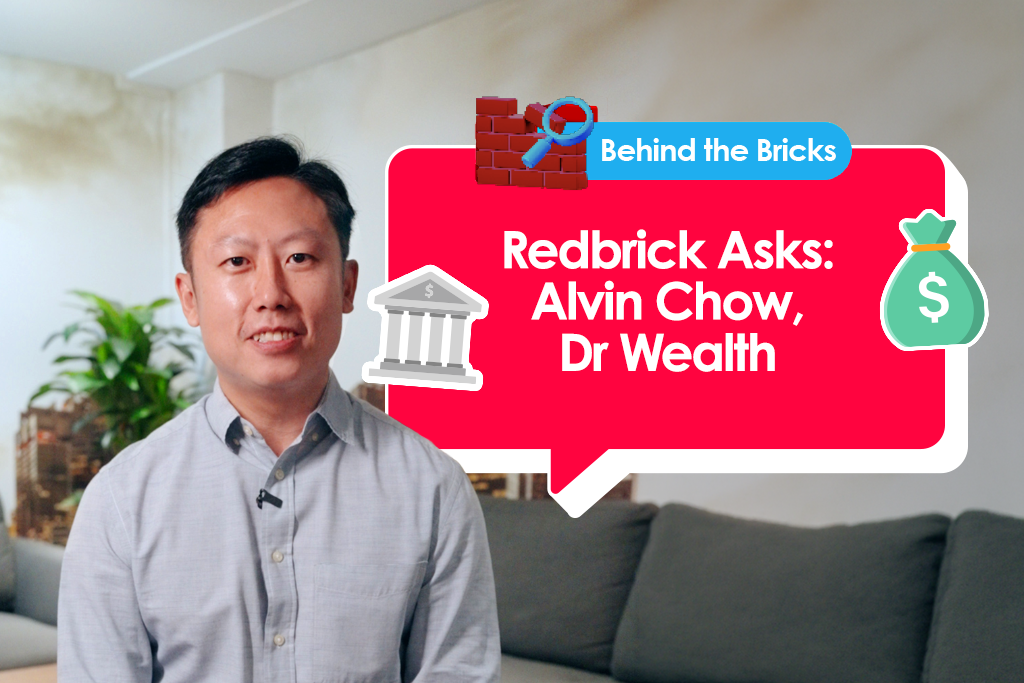
Q. What’s one piece of advice you would give to first-time homebuyers?
Alvin: My one piece of advice for first-time buyers is don’t overstretch your finances. Do your sums properly and make sure that your monthly mortgage payment is highly comfortable. You do not want to stretch to the very last cent that you have just to hit a specific property price tag, because you absolutely do not want to end up as a mortgage slave. Some basic financial prudence is absolutely necessary here.
Q. Is there a ‘best time’ to buy a property?
Alvin: It completely depends on whether you’re buying a property for homestay or for investment purposes. If it’s for homestay, the best time to buy is simply when you need a place to stay, because delaying it for years just to wait for prices to drop will disrupt your daily life.
For investment property, you aren’t up against a clock. You have a lot more time to do your homework, conduct your due diligence, and objectively look at whether there is strong capital appreciation potential or if the rental yield is high enough to comfortably cover your mortgage payments. The best time to buy for investment is after you have fully analyzed the numbers and you are ready to write the cheque.
Q. Would you buy a home to live in, or as an investment?
Alvin: I would buy a property mostly to live in. When looking at real estate strictly as an investment asset, I always strictly compare its expected returns against other investments to see which asset class offers a better ROI. Right now, from a pure numbers perspective, I believe equities are still a better tool for growth, so I prefer to separate the two.
Q. When choosing a home loan, do you prefer fixed or floating interest rates?
Alvin: I definitely prefer a fixed interest rate because it is great for financial planning. With a fixed rate, I know exactly how much I need to foot for the mortgage payment over the next few years without any unexpected surprises.
Macro interest rates can go up or down, and they are incredibly difficult to predict. We saw a prime example of this before 2022 when floating rates were under 2%; many homeowners opted for floating bank loans to save money, believing rates would stay low forever.
But when rates spiked in 2022 and 2023, those floating payments ballooned rapidly and screwed up a lot of people’s finances. It’s a classic lesson in how trying to outsmart the market can end up being “penny wise and pound foolish.”
Q. When taking a loan, do you think it is better to borrow more or pay it off as quickly as possible?
Alvin: If you look at the data, Singapore private property has appreciated by about 4% per year over the last decade. Property investment is highly lucrative specifically because of leverage—if you use 4x leverage, a 4% growth rate effectively boosts your actual returns to above 10% p.a.
Plus, property loans are relatively cheaper than almost any other type of leverage offered by banks. Because of this, it makes sense to borrow more, but you must do so responsibly. You should only leverage up to the point where your monthly payments remain highly manageable.
You have to account for risk—if your investment property sits vacant for a few months without a tenant, you need to be certain you can cover the entire mortgage out of pocket without breaking a sweat.
Q. What advice would you give someone who wants to start investing in property?
Alvin: Don’t mix homestay decisions with investment property decision-making. Buying a home is an inherently emotional activity; you walk into a space, you look at the layout, and you try to “feel” it.
For a homestay, it is completely fine if your feelings guide you because you have to live there. But for an investment property, your personal preferences do not matter at all because you are renting it out.
You have to evaluate the asset with absolute objectivity. You need to look at the hard data: Who are the target tenants? What is the exact ROI and rental yield? What are the factual capital gains trends? For investment, let the hard numbers do the talking and keep your emotions out of it.
Q. Who or what influenced the way you think about investing?
Alvin: I’ve had many influences over the course of my career, but the world of factor investing is what truly shapes my framework and what I still actively practice today. Factor investing is entirely data-driven and relies on heavy empirical evidence to explain why certain asset characteristics deliver consistent returns.
Because of this background, my approach to any asset—including property—is to strip away the marketing hype, analyze the historical numbers, and identify the absolute best investment based on data.

Source: Dr Wealth
Q. Do you think property is a good way to build long-term wealth?
Alvin: Yes, property is absolutely one of the core wealth-building mechanisms available to people. Singapore is a very unique and highly resilient market because land is inherently scarce and supply is limited. As the population grows, demand remains strong, which keeps our property prices much more stable and resilient than in countries with boundless land to build on. When you couple that geographic scarcity with the responsible use of bank leverage, you can significantly amplify your long-term returns.
Q. Do you think owning property should be part of your retirement plan?
Alvin: Most Singaporeans view it that way because having a roof over your head provides a deep sense of psychological security. However, from a financial perspective, a property during retirement is often more like leaving a locked inheritance for your beneficiaries rather than a practical tool for retirement.
Retirement is entirely about cash flow—you need liquid cash to pay your daily living expenses, and a homestay locks up a massive amount of your funds. That’s why we see the government introducing tools like reverse mortgages or shorter leases to help retirees unlock that trapped liquidity.
Ultimately, property only works as a retirement plan if you have extra rooms or additional properties that you can actively rent out to generate consistent, ongoing income.
Q. If you could restart your property journey, what would you focus on most?
Alvin: I would focus on choosing a better stack with a superior view. Real estate is a highly heterogeneous market; no two units are identical, and even within the exact same condominium project, certain stacks hold a vastly higher premium.
Those prime units are the ones that command better prices and sell faster down the line. Additionally, when it comes to renovations, I would advise thinking long-term. We tend to heavily over-optimize our interior design for our immediate, short-term needs, only to realize a few years later that our lifestyle has completely changed and the layout no longer fits us—but by then, it’s rarely worth the high cost of tearing it down and renovating all over again.