

For many Singaporeans, buying real estate is viewed simply through the lens of emotion or pure numbers, but Timothy Tay wants you to look at the broader perspective. As the Editor-in-Chief of Stacked, Timothy brings an incredibly rich depth as a business and real estate journalist. He possesses a rare, bird’s-eye view of Singapore’s fast-evolving housing market.
Timothy cuts through casual market speculation to address the hard realities facing buyers today—from navigating the complex minefield of modern real estate jargon and policy shifts like Prime BTO subsidy clawbacks, to the high-barrier frontiers of commercial property investment.
Q. What’s one piece of advice you would give to first-time homebuyers?
Timothy Tay: Never start your property journey with the notion that a touch-and-go approach towards understanding the market and your housing needs is adequate.
Singapore has one of the most dynamic housing markets in the world, with thousands of new Build-To-Order (BTO) flats and condominium units entering the market each year. Moreover, the path to buying your first home is lined with milestones that each require knowledge in different areas.
Whether you plan to buy a BTO unit, a resale flat, or a condo, going in with a general understanding of how prices in the area have moved, as well as existing and future developments that could shape the area, will elevate your decision making.
It will also take you time to navigate the minefield of real estate jargon, including aspects of property finance, that will be needed before you successfully collect the keys to your first home.
Read or listen to property news regularly to learn what’s going on in the market. There is a plethora of market commentaries and opinions available but be discerning and analytical.
Q. Is there a ‘best time’ to buy a property?
Timothy Tay: Yes, I would argue that depending on each individual’s needs at the time, there is a so-called best time to buy a property.
Part of this stems from experiences others have shared with me where they pondered too long or did not have their finances set up in time, to move quickly to secure the right property purchase. This often meant that they missed out on their desired unit at a price that worked best for their financial situation.
Of course, there is the overarching question: at what point in your life should you buy property. There is no straight answer, since this depends on individual factors that I can’t break down here.
Q. Would you buy a home to live in, or as an investment?
Timothy Tay: If you have the means, then owning a home to live in should be the priority.
This property can still be used to fund an upgrade when it is sold at the right time, but prevailing policies mean that the holding period before this happens tends to be much longer than it was previously.
For the average Singaporean, it has become more challenging to purchase a home as an investment property, with the goal of reaping significant profits while being able to afford a suitable replacement home.
Subsidy clawbacks for Plus and Prime BTO flats, which has scaled to a high of 14% in some projects, as well as higher property prices in suburban housing markets looks set to erode most of the resale gains that would have traditionally justified the case for purchasing a home as an investment.
All of this means that it is much more prudent to buy your first home to live in, and if you have the means, then explore other ways to purchase other types of property for investment.
Q. When choosing a home loan, do you prefer fixed or floating interest rates?
Timothy Tay: So far, I’ve gone with fixed interest rates – since I have been fortunate to see relatively low rates when I had to take out my mortgage, and when I had to refinance it.
Q. What advice would you give someone who wants to start investing in property?
Timothy Tay: In my view, picking the right property agent and financial advisor can make or break the success of an investment portfolio.
Successfully investing in real estate today requires a level of specialised market knowledge that casual investors will find it challenging to navigate on their own. This requires more than an academic understanding of investment strategies which are peddled to hopeful investors.
High additional buyer stamp duty (ABSD) rates make investing in residential properties prohibitively expensive for most retail investors. Thus, the investment spotlight has turned to select commercial and industrial properties.
These real estate markets are not like the residential market. The degree of transparency in terms of properties for sale, asset values, prices, yields, and transactions volumes is a high barrier to entry.
It takes the right kind of advisor to navigate these waters, especially for investors looking to step in for the first time.
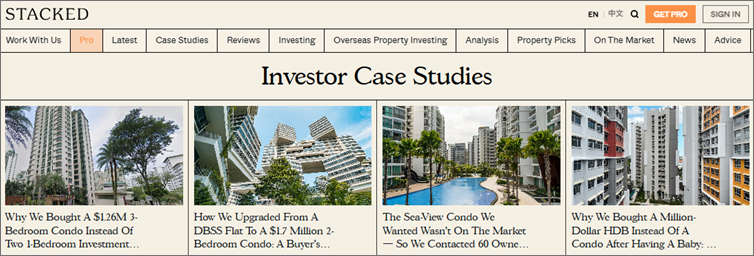
Source: Stacked
Q. Who or what influenced the way you think about investing?
Timothy Tay: A consistent observation of Singapore’s development plans, as well as price trends, has contributed to my perspective of the local real estate market and the investment approaches that different actors and stakeholders deploy.
I’ve also been very fortunate in my career to speak to a very diverse range of players in the market, from CEOs of listed property developers to multinational asset managers, heads of research and consultancies, as well as the buyers and sellers making waves in the market.
This broad exposure over an eight-year long career as a real estate writer has shaped the way I approach investing in the real estate market.
Q. Do you think property is a good way to build long-term wealth?
Timothy Tay: In general, owning property has been the most stable means of securing household wealth among most Singaporeans. While the return on this investment has fluctuated over the years, it has been resilient as a store of wealth.
It has been come more challenging for the typical Singaporean household to turn property into a form of long-term wealth, since acquisition costs have climbed over the years and financing has become stricter.
We should be mindful of how the generational accumulation of wealth has the potential to widen income disparities. Today, a significant proportion of new private home sales are funded by parents purchasing homes for their children – this is not inherently bad.
But coupled with rising property prices, we should explore if there is a risk of a shrinking group of Singaporeans who will be able to build this kind of long-term wealth.
Q. Do you think owning property should be part of your retirement plan?
Timothy Tay: For most Singaporeans, owning property should remain a part of their retirement plan. It has a proven track record as a good store of wealth, and realising the profits from one or more properties can contribute to a more comfortable retirement lifestyle.
On the other hand, long-term changes are afoot which may add more options for retirees. In recent years, we’ve seen the introduction of alternative housing arrangements, such as co-living for seniors and long-term assisted living eldercare developments have cropped up.
In addition, the promise of a more convenient and reliable cross-border travel between Singapore and Johor could open the door for more Singaporeans to plan their retirement there instead. The allure of a more affordable cost of living in Johor has spiked interest in properties there, although it has yet to fully translate into property purchases.