

The honest answer depends on what you’re actually trying to do and most people never ask that question before they buy.
Everyone seems to have an opinion on this one. Commercial gives you better yields. Residential is safer. Office is dead. Shophouses are the play. The takes are everywhere and half of them are right, depending on what you’re optimising for. That’s the part that gets skipped.
So let’s actually look at both. Not the pitch version but the real version, with the vacancy numbers, the ABSD implications, and the scenarios where each one earns its place.
Why residential keeps outperforming expectations
Here’s the thing about residential property in Singapore: it’s not built on sentiment. It’s built on necessity. People need somewhere to live whether the economy’s up or down, and that fundamental demand floors the downside in a way commercial simply can’t match.
The vacancy data makes this concrete. Private residential vacancy rates sat at around 6.0% in Q4 2025, according to URA, it is down from 6.9% the quarter before. Suburban projects were even tighter at roughly 4.9%. Compare that to office vacancy at 11.1% in the same period. That’s almost double. The gap isn’t a blip; it reflects a structural difference in how these asset classes hold up under pressure.
Capital appreciation tells a similar story. Private residential prices rose 3.3% in 2025, continuing a multi-year trend. And unsold inventory dropped to roughly 15,000 units, strong demand absorption even as new launches kept coming. Treasures at Tampines is a clean example of what this looks like on the ground: launched at around S$1,280 psf in 2019, resale transactions were crossing S$1,650 to S$1,750 psf by 2024-25. That’s 30 to 35 percent appreciation in five years. Not driven by speculation, but by genuine upgrader demand.
There’s also a liquidity advantage that doesn’t get enough attention. The buyer pool for residential is wide, first-timers, HDB upgraders, investors, PRs. That breadth means you can exit when you want to, not when the market happens to produce a buyer. In commercial, you’re fishing in a much smaller pond.
The trade-off is yield. Residential rental returns in Singapore typically sit between 2 and 3 percent. If monthly cash flow is what you’re after, that number is going to frustrate you.
The commercial case for income, scale, and no ABSD
Commercial property operates on a completely different logic. The yields are higher — 4 to 6 percent or more. Depending on the asset and the lease structures are genuinely better for landlords. Three-to-five year tenancies. Built-in rental escalation clauses. Tenants often picking up maintenance and operating costs. If you want predictable income that compounds over time, commercial has a legitimate argument.
But the structural advantage that doesn’t get nearly enough airtime is this: commercial properties aren’t subject to Additional Buyer’s Stamp Duty. For residential, ABSD can run from 20 to 60 percent depending on your profile. A number that fundamentally changes the economics of owning multiple properties. Commercial sidesteps that entirely. For investors who’ve already maxed out their residential exposure and want to keep building, this matters enormously.
And when the right asset is selected, the upside can be exceptional. Conservation shophouses in Singapore’s CBD, valued at around S$4 million in the early 2000s, are now changing hands above S$20 million. Roughly 400 to 500 percent appreciation over two decades, driven by genuine scarcity and location.
| 💰 What the numbers actually show A strata office at S$800,000, rented at S$3,200/month, looks like a 4.8% yield on paper, but four to eight months of vacancy between tenants can halve that effective return. A suburban retail unit at S$1.2M with S$5,000/month rent yields around 5%, until a six-month vacancy gap drops it to 3 to 3.5%. The gross yield is what commercial offers. The net yield is what you keep. They’re not the same number. |
The vacancy problem nobody warns you about
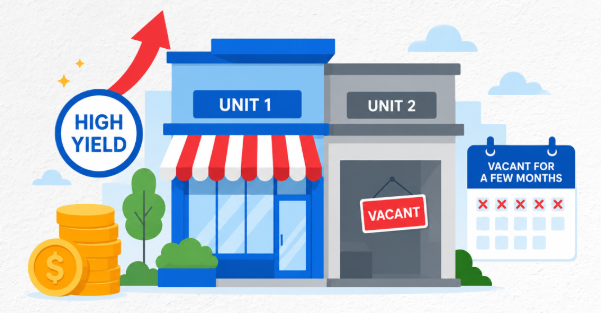
Commercial vacancy is the number that changes everything. At 11.1% for offices in Q4 2025, you’re looking at a real probability of sitting with an empty unit for months at a time. And unlike a vacant residential flat, where a fresh tenant is usually a few weeks away. A commercial unit without a tenant can stay dark for quarters. Finding the right fit takes longer. The tenant pool is smaller. And every month it sits empty, your “high yield” investment is generating exactly nothing.
This is the risk profile that catches people out. Commercial looks better on paper until the lease expires and the next tenant takes six months to materialise. Suddenly the 5% yield you underwrote is a 2.5% year. That’s not a disaster, but it’s not what you planned for either.
Commercial property rewards investors who understand tenant dynamics, lease cycles, and sector-level demand. It punishes people who bought on yield alone.
So which one is actually right for you?
Here’s the honest breakdown.
Residential makes the most sense if you’re building long-term wealth and want something that compounds steadily, stays liquid, and doesn’t require deep sector knowledge to manage. It’s also the right starting point for most investors, the financing terms are better, the buyer pool is deeper, and the downside is better floored. The yield won’t excite you. The capital growth over a decade might.
Commercial makes sense if income and cash flow are the primary objective, if you’ve already got residential exposure and ABSD is constraining your next move, or if you have the market knowledge to identify the right asset in the right location. Shophouses, well-located strata offices, suburban retail in high-footfall areas, these can all deliver strong returns. But “commercial property” is not one thing. It’s a category with enormous variance, and yield alone is not a thesis.
The smartest investors don’t treat this as binary. Residential for the foundation, the stable, appreciating core. Commercial for the income layer, once you have the capital and the conviction. The two can complement each other well when each is doing the job you actually need it to do.
One question before you decide
Before you go down either path, it’s worth getting clear on one thing:
“Am I optimising for capital growth, for monthly income, or for both — and do I have the holding power to weather a vacancy if things don’t go to plan?”
If you’re clear on that answer, the right asset class usually becomes obvious. If you’re not — that’s where the thinking needs to start, before you commit capital in either direction.