

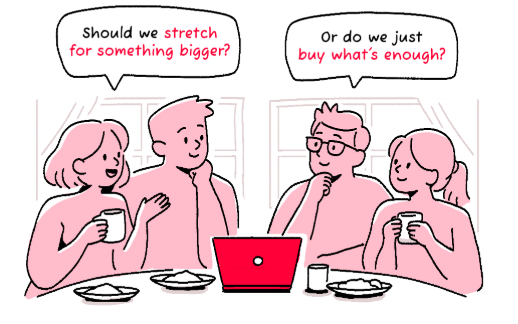
It usually happens on a weeknight. Dinner’s cleared, the toddler is finally asleep, and one of you opens the laptop “just to look.” Twenty minutes into scrolling listings, somebody says it out loud.
“Should we stretch and get something bigger? Or just get something that’s enough?”
First, “bigger” doesn’t always mean more space
Sometimes bigger is literal. A 4-room HDB to a 5-room. One more bedroom, a bit more room to grow into. Sometimes it’s a change of category altogether. A 4-room flat to a 3-bedroom condo, which isn’t just more space. It’s a different lifestyle, different facilities, a different price quantum.
And sometimes bigger has nothing to do with square footage at all. Same size unit, different location. Move from the Outside Central Region to the Core Central Region, the prime districts around Orchard and the CBD, and the price tag alone makes it feel like a leap.
“Enough” is harder to define, because it has less to do with numbers and more to do with intent.
The case for stretching, you’d rather do this once
Picture a couple with one child, two years old. Almost nothing about the next ten years is settled. A second kid, maybe. Parents moving in one day, possibly. Space getting tight sooner than expected, who knows.
Buying bigger is a way of answering those questions early, before you’re forced to. It’s a decision about stability. Settle once instead of moving twice.
And moving twice is more expensive than people expect. Stamp duties and legal fees are the obvious costs. The quieter ones do more damage. Renovating a 3-bedroom condo so it actually feels like home can run $100,000 or more. Agent fees on a $1.5 million property come to roughly $30,000. Stack everything else on top and each move becomes a financial reset.
None of that compounds. It just reduces what you get to keep.
Then there’s the arithmetic of property itself. Growth gets quoted in percentages, but you feel it in dollars. A 4% rise on a $2 million home is $80,000. The same 4% on a $1 million home is $40,000. Same market, same year, twice the outcome. The bigger the base, the more every move in the market is worth to you. And in the right locations, family-sized units tend to hold steady demand, which supports value over the long run.
| 📐 The cost of moving twice Renovating a 3-bedroom condo: $100,000 or more. Agent fees on a $1.5 million property: around $30,000. Add stamp duties and legal fees, and a single move can quietly cost you six figures. Do it twice in a decade and that’s a real chunk of your gains, spent before you’ve earned them. |
But the cash you don’t spend is doing something too
Now take the same couple with a different outlook. They’re sure about one child. Their parents are financially independent and settled where they are. A 2-bedder already fits their life comfortably.
By choosing not to stretch, they keep something that’s easy to undervalue, liquidity. Cash on hand is optional. It can go into investments, fund a business idea, or sit ready for a second property down the line. More than that, it creates breathing room.
The line item that never makes it into the spreadsheet
A big mortgage doesn’t just sit quietly in the background. It shapes things. How freely you can take a career risk. Whether starting something of your own feels exciting or reckless. How you feel every time you check the account at the end of the month.
You can’t put a number on that. You feel it anyway.
Buying enough isn’t holding back. It’s choosing a level of commitment that lets the rest of your life stay flexible.
Enough doesn’t mean smaller. Sometimes it just means smarter.
There’s a common assumption that buying enough means compromising on space or quality. Not necessarily. Often it just means buying differently.
At $1.5 million, a new launch might get you around 600 square feet, a decent slice of which is balcony. A resale unit at the same price could give you more usable space, a more efficient layout, and a lower cost per square foot. Same budget but very different value.
So what stage are you actually at?
There’s no universally right answer here and anyone who tells you there is, probably has something to sell. For some people, buying bigger buys peace of mind. The decision is made, the family has room to grow into and nobody has to revisit it in four years.
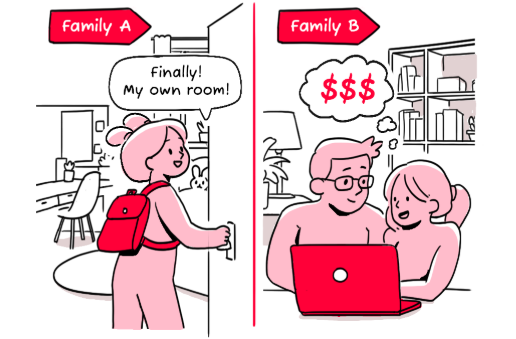
For others, buying enough buys a different kind of peace. Options. The quiet confidence that the home supports the life rather than dictating it.
Both work. Both cost you something.
Because at the end of the day, a property is just a tool. And the goal isn’t to maximise the tool. It’s to use it in a way that allows you to live well.