

This is the million-dollar question, isn’t it? The one your financial advisor, your buddy who trades crypto, and your property agent all give you a different answer to.
On the surface, it seems like an easy call. Just look at the raw numbers from the last 20 years:
- S&P 500: A stunning average total return of around 10.5% per year.
[source: Historical Average Stock Market Returns for S&P 500 by TradeThatSwing] - Singapore Private Property: Average capital appreciation of about 4.8% per year, plus a rental yield of roughly 3%.
[Source: Gross rental yields in Singapore: Newton/Novena and 5 other areas by Global Property Guide] - STI (Singapore Stocks): A respectable total return of approximately 7.3% per year.
[Source: SPDR® STRAITS TIMES INDEX ETF by State Street Investment Management]
Based purely on this, the S&P 500 seems to be the obvious choice, right? It’s a no-contest. But focusing only on historical returns is the biggest mistake you can make. The numbers don’t tell the full story.
The 5 Key Factors You’re Not Thinking About
The real difference between these assets isn’t in their past performance, but in their fundamental characteristics.
1. Leverage: The Ultimate Secret Weapon
This is the game-changer. With private property in Singapore, you can borrow up to 75% of the property’s value at incredibly low interest rates. This allows you to control a multi-million-dollar asset with a fraction of the capital.
- With $500,000 in stocks, you can only buy $500,000 worth of stocks (ignoring expensive and risky margin loans). Your returns are on that $500,000.
- With $500,000 in property, you can buy a $2 million condo (assuming you have sufficient income). Your returns are on the full $2 million value.
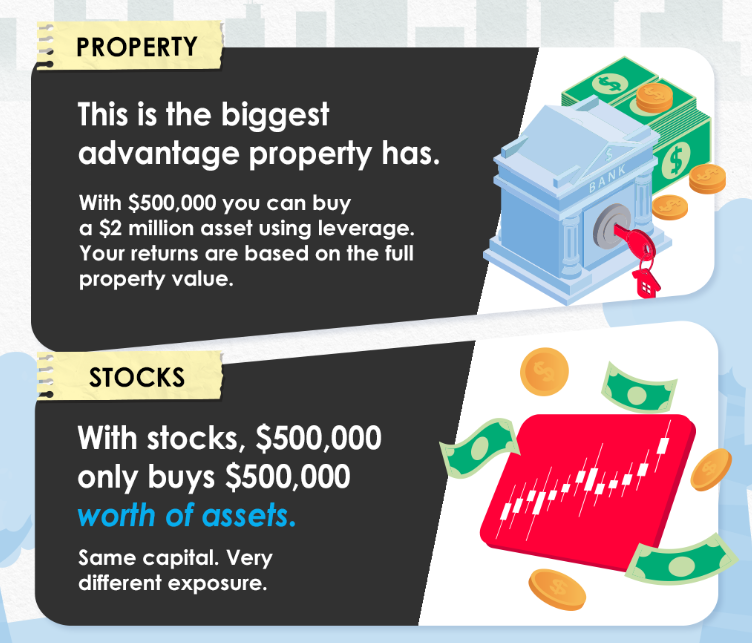
This ability to multiply your exposure is a level of leverage that stocks simply can’t replicate for the average investor.
2. Liquidity: The Trade-off
Stocks can be bought and sold in seconds. That’s fantastic if you need to access your cash immediately, but it’s also why you can lose a huge chunk of your wealth overnight during a market crash.
Property is the opposite. It can take months to sell. This illiquidity acts as a form of natural “cooling measure” against panic-selling. You can’t impulsively offload your asset, which often protects you from making emotional decisions during a downturn.
3. Volatility: The Shock Absorber
The S&P 500 can and will experience massive swings. In a single month during the COVID-19 crash, it plummeted by over 34%. Property prices, on the other hand, are stickier. They tend to trend up or down slowly, with market-wide corrections rarely exceeding a few percentage points in a single quarter. This makes property a much more stable store of wealth.
4. Cash Flow: A Tale of Two Yields
Both can generate income, but they do it differently.
- Private Property: A decent rental yield of around 3% provides a consistent stream of passive income that can help cover your mortgage.
- S&P 500: The dividend yield is much lower, typically around 1.5% to 2%. While it’s great for reinvesting, it’s not a strong source of immediate, ongoing cash flow.
5. Tax & Rules: The Playing Field
Both stocks and property in Singapore are free from capital gains tax, which is a huge advantage. However, property comes with significant transaction costs like stamp duties. This is a one-time fee, but it’s a major barrier to short-term speculation.
A Mind-Blowing Takeaway
Let’s re-run the numbers with that mind-bending concept of leverage.
Assume a 35-year-old with $500K capital over 5 years:
- Stocks: Your $500K grows at the STI’s 10.5% average annual return, giving you a final value of approximately $711,000.
- Private Property: With your $500K down payment, you buy a $2 million condo. If it only appreciates by 4.8% annually and you get a 3% rental yield, your final equity after all costs is roughly $1,090,000.
Even with the STI’s higher historical return, the power of leverage makes the final outcome of the property investment more than double the returns from STI.
The Wealthy Don’t Choose, They Blend
This isn’t an “either/or” debate. The smartest investors understand that these assets are not competitors; they are complements.
- Property provides the stability and leverage for long-term, foundational wealth building.
- Equities provide the growth and liquidity to take advantage of market opportunities.
They serve different purposes in a balanced portfolio.
So, if you had to commit $500,000 right now for 10 years—which would you choose, and why?