

Here’s a scenario most people recognise. Two friends buy in the same general area — one jumps in early, one waits until things “look clearer.” Five years later, one of them is sitting on a significant gain. The other is paying more to enter a market that’s already moved.
Which one made the smarter call? That depends entirely on what they were trying to achieve — and whether they understood the phase of the cycle they were entering.
The buy-early-versus-wait debate is one of the most common in Singapore property. And the honest answer is: neither side is always right. But there’s a more useful way to frame the question.
The case for going in early
Singapore’s property market follows a fairly consistent pattern: announcement → construction → completion → maturity. Buy early enough in that cycle and you’re not just buying a unit — you’re buying into multiple waves of potential appreciation.
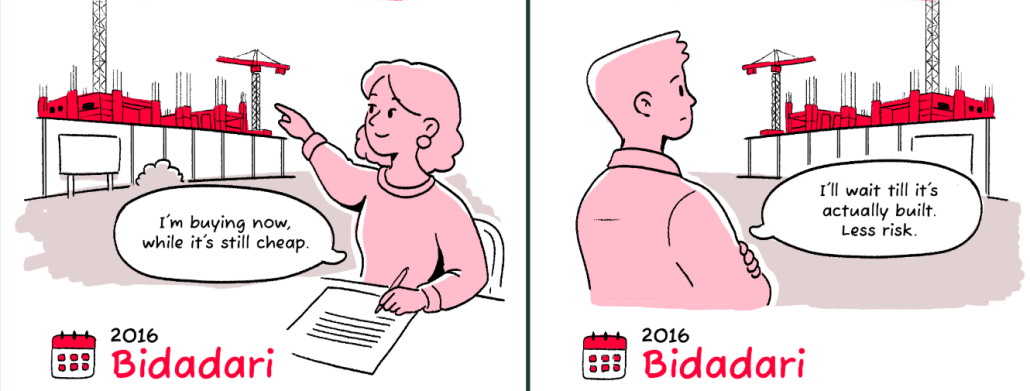
Bishan is the textbook example. 5-room HDB prices there have grown roughly 43% since 2014, with some private sellers booking over $1 million in profit. Bidadari is more recent and more dramatic: 4-room flats launched around $468K–$570K in 2016. By 2025, transactions were hitting $1.2M–$1.3M. Nearby Woodleigh private developments saw 60–80% price growth over the same period.
These numbers are real. And they’re the reason “buy early” is such a persistent piece of advice in Singapore property circles.
| 💰 What the numbers actually show Early buyers in Bidadari paid ~$500K for a 4-room flat in 2016. That same flat hit $1.3M by 2025. That’s not a rounding error — that’s transformation risk paying off. But early Jurong Lake District buyers in 2014 waited six years just to break even after the KL–Singapore HSR was cancelled. Early doesn’t automatically mean better. It means you’re taking on more uncertainty in exchange for more potential. |
The case for waiting it out
Waiting for an area to mature isn’t timid. It’s a legitimate strategy — and in some situations, it’s the smarter one.
When infrastructure is complete and demand is already visible, you’re buying with more certainty. You can rent out immediately. You can see the actual footfall, the actual amenities, the actual commute times. That information has value.
The trade-off is obvious though: by the time everyone can see it, the price reflects it. Jurong Lake District is a useful cautionary tale on both ends — early buyers got burned by HSR optimism, but later buyers who entered post-2020 did capture meaningful appreciation as the area’s fundamentals became clearer. Woodlands Regional Centre followed a similar arc. Announced in 2013, prices barely moved through 2016–2020. Then, as development actually became visible, the market responded.
The lesson isn’t “early is risky, late is safe.” It’s that both strategies have a version that works and a version that doesn’t.
The phase that actually matters
Here’s where experienced investors think differently. They’re not asking “early or late.” They’re asking: what phase of the cycle is this area in right now, and is the current price reflecting that phase accurately?
The sweet spot most of them target is what you’d call the early visibility phase. Not speculative, not fully priced in. Infrastructure is confirmed — not just planned. Development is already underway. But prices haven’t yet fully adjusted to reflect what’s coming.
The Thomson-East Coast Line corridor is a clean illustration. In areas like Woodlands and Lentor, some developments saw roughly 15% price growth between 2018 and 2023 — before the MRT stations were even fully operational. The market was pricing in confirmed future connectivity, not just a promise.
That’s the window. Not before the announcement. Not after the ribbon-cutting. Somewhere in between, when the risk has come down but the upside hasn’t disappeared.
The real question to ask yourself
Before you decide where in the cycle to enter, you need to answer something more personal: what are you actually optimising for?
If you’re buying to stay — especially with young kids or a fixed commute — the early-phase risks (limited amenities, construction noise, a rental market that doesn’t exist yet) are real-life problems, not just investment footnotes.
If you’re investing and can hold for 7–10 years, early-phase entry in the right transformation area can be one of the most effective positions you can take. You just need to be genuinely comfortable sitting on paper gains that might not appear for years — and paper losses that might show up first.
And if you need rental yield from day one, waiting for maturity makes more practical sense, even if you’re giving up some upside.
For any emerging area — whether it’s Springleaf, the Greater Southern Waterfront, or wherever the next URA Master Plan cycle points — the checklist is the same. Are there confirmed developments that will land within your holding period? Is the current pricing genuinely ahead of fundamentals, or just catching up to confirmed plans? Are you entering on visibility — or on hope?
Timing isn’t about being first. It’s about being right.
The investors who consistently do well in Singapore property aren’t the ones who always buy first or always wait longest. They’re the ones who are honest about what phase they’re entering, what they’re buying it for, and how long they can hold.
Enter too early and you might be holding something flat for six years while your cash could have been working elsewhere. Enter too late and you’re paying someone else’s upside.
The better question isn’t “Shouldn’t I buy now before prices go up?” or “Shouldn’t I wait until it’s safer?” It’s “Am I entering at the right stage of this cycle for what I actually want to achieve?”
Get that question right, and the early-versus-late debate mostly answers itself.