

I’ll never forget the day my parents sold the home we grew up in. It was a bittersweet moment. On one hand, the sale brought financial relief—it was a way to fund my siblings’ and my university education. The property was fully paid off, and my father said with pride, “It’s the least we can do.” On the other hand, we were letting go of a place filled with memories.
At the time, selling seemed like the only logical option. The equity in the house felt “locked in.” The rental income wasn’t enough to cover our tuition fees and living expenses, and we needed a large sum of cash, fast.

In 2006, we sold the house for about S700,000. Just a few months later, the market rebounded and the same property could have fetched closer to S1,000,000. That stung—but the bigger realization came years later.
We didn’t need to sell at all.
The Power of Leverage We Never Knew About
Most people see borrowing as “debt”—a financial burden that you should avoid at all costs. But the truth is, not all borrowing is bad. When you take a loan to buy something that generates income and grows in value, that’s not just debt; it’s a strategic use of leverage.
Leverage is a tool that allows you to use borrowed money to increase your investment in an appreciating asset. Think of it this way: instead of putting up the full S$700,000 to buy a property, you use a loan for a significant portion of it. This frees up your cash to invest in other areas, and you get to benefit from the full value appreciation of the property.
In my family’s case, our home was a fully paid-off asset. We had 100% equity locked in. What we should have done was leverage that equity. By taking a loan against the property, my parents could have unlocked the funds needed for our education while retaining ownership of an asset that was set to double in value.
This is a powerful concept. It allows you to seize opportunities you would otherwise miss due to a lack of immediate funds, and your potential returns on the investment can be far higher than the cost of the loan interest.
The True Cost: What We Lost
By selling the property, here’s what we thought we gained:
- S$700,000 cash in hand
- No liabilities
But here’s what we actually lost:
- Ongoing rental income: A conservative S$3,000/month, which would have added up to hundreds of thousands over the years.
- Future capital appreciation: An average gain of S$50,000 per year, which would have seen the property’s value more than double in the long run.
- An asset for generational wealth: The home could still be a part of our family’s wealth today, instead of being a past memory.
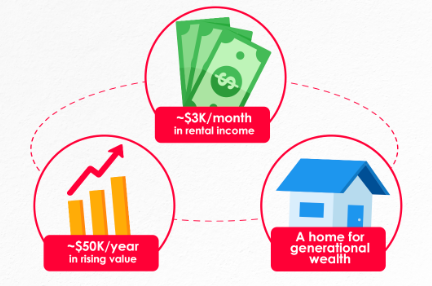
The real cost wasn’t just the sale price—it was the massive opportunity cost of giving up a low-cost, appreciating asset.
Why This Matters for You
This isn’t just my family’s story; it’s a cautionary tale for anyone in Singapore. If you (or your parents) are sitting on a paid-off or low-leverage property, selling isn’t always the smartest way to unlock funds.
When used wisely, leverage can be one of the most powerful tools for building and preserving generational wealth. It allows you to unlock the potential of your assets without giving them up.
So, ask the hard questions. Speak with a trusted mortgage advisor. Explore options like refinancing or an Equity Term Loan before making a decision that could cost you hundreds of thousands down the road.
Because sometimes, wealth isn’t about how much you have—it’s about how smart you are in using it. And if I had known that back then, my family’s story would have been very different.