

“Buy, flip, and recycle the capital.”
If you’ve spent any time at all talking about property in Singapore, you’ve heard this from your relatives, your friends, and probably a property agent. It’s the gospel of wealth-building, and for a long time, it’s worked for many. The logic is simple enough: Singapore is small, we’re expecting more people, and the demand for homes will always outstrip supply.
It all sounds great on the surface.
But what if that’s not the whole story? What if the days of aggressive, easy gains are behind us?
Let’s be honest, the global economic landscape is far more uncertain now than it was over the past two decades. The notion of ever-rising incomes and GDP is no longer a given. And more importantly, the narrative conveniently leaves out all the hidden costs that eat into your profit.
The Hidden Costs That Quietly Steal Your Returns
A property’s price tag is just the beginning. The real story of your returns is written in the fine print. These are the costs that chip away at your capital and can turn a seemingly profitable flip into a marginal gain.
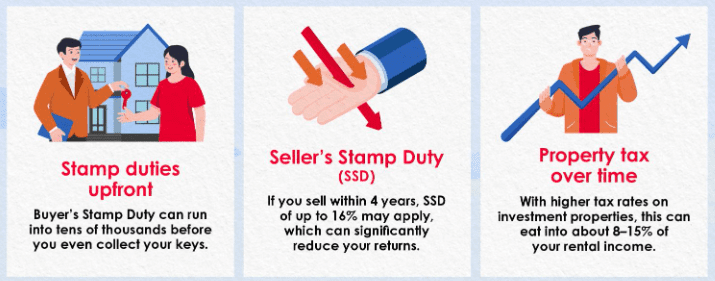
- Stamp Duties: The most obvious one. Buyer’s Stamp Duty (BSD) is a significant upfront cost that can run into the tens of thousands of dollars, or even hundreds of thousands for a high-value property.
- Seller’s Stamp Duty (SSD): If you’re looking to “flip” a property within three years, you’ll be hit with a hefty tax of up to 12% on the selling price. This single tax is designed to kill the flipping strategy and can wipe out your profits completely.
- Property Tax: This is an ongoing annual expense that increases with your property’s Annual Value (AV). For a non-owner-occupied investment property, the tax rate is substantially higher.
- Maintenance & Conservancy Fees: For a condo, these can run from a few hundred to over a thousand dollars a month. Over a 5- or 10-year holding period, this adds up to tens of thousands of dollars.
- Renovation & Furnishing: A resale home often needs a fresh coat of paint and some upgrades. A full-scale renovation for a 4-room HDB flat can easily cost between $50,000 to $80,000, money you might never get back if you buy at a peak.
- Borrowing Costs: With rising interest rates, the cost of servicing your home loan is no longer a minor consideration. The interest paid on a loan over 20-30 years can amount to a substantial portion of the original property price.
The Brutal Truth About Illiquidity
Here’s the one thing no one tells you: property is an illiquid asset.
You can’t just sell it in a day. It takes months, sometimes even longer, to find the right buyer at the right price. This means your entry and exit prices matter more than most people realize.
- Buying High, Selling Low: Buying an overpriced unit in a superbly developing location will not guarantee a profit. The hype of future growth is already priced in. Your entry price is already so high that any future gains are likely to be minimal, or worse, non-existent.
- Buying Undervalued, Selling Sideways: On the flip side, buying an undervalued property in a stagnated area won’t maximize your upside. If there’s no underlying fundamental growth, your property’s value will likely just sit there, failing to beat inflation.
Beyond the Hype: How to Find Real Value
I’m not saying there are no opportunities left in the market. The opportunities are still there, but you have to look past the superficial hype and into the cold, hard fundamentals.
Before you make a decision, you need to dig into:
- Transaction Volume: Is the area healthy and active, or are transactions stagnant? High volume indicates demand and liquidity.
- Fair Market Valuation: Is the price you are paying a fair one, or are you paying a premium for nothing more than a good story? Compare recent sales of similar properties in the immediate vicinity to determine a realistic value.
- Area Growth Potential: Does the area have confirmed plans for new MRT lines, schools, or business hubs? Look for tangible, government-backed plans, not just wishful thinking.
In today’s market, property is not a simple “buy and hold” game. It’s a strategic long-term play that requires discipline, research, and a clear understanding of all the variables. The smart money isn’t chasing the next big thing; it’s buying a solid asset at a fair price and holding for the long run.
Read “From Humble Beginnings to $10 Million: How Smart Property Moves Led to Jack and Jill’s Financial Freedom” about how Jack and Jill retired at 65 with two fully paid properties worth a combined $10 million. They had a net worth of $10 million and, more importantly, a passive income of $20,000 every single month.
The most incredible part? They achieved all of this without ever touching their personal savings. Their journey is a testament to the power of strategic property investment:
Their story isn’t just a narrative; it’s a blueprint. It shows that with calculated risks, smart leverage, and a long-term vision, financial freedom isn’t a distant dream – it’s an achievable reality.